
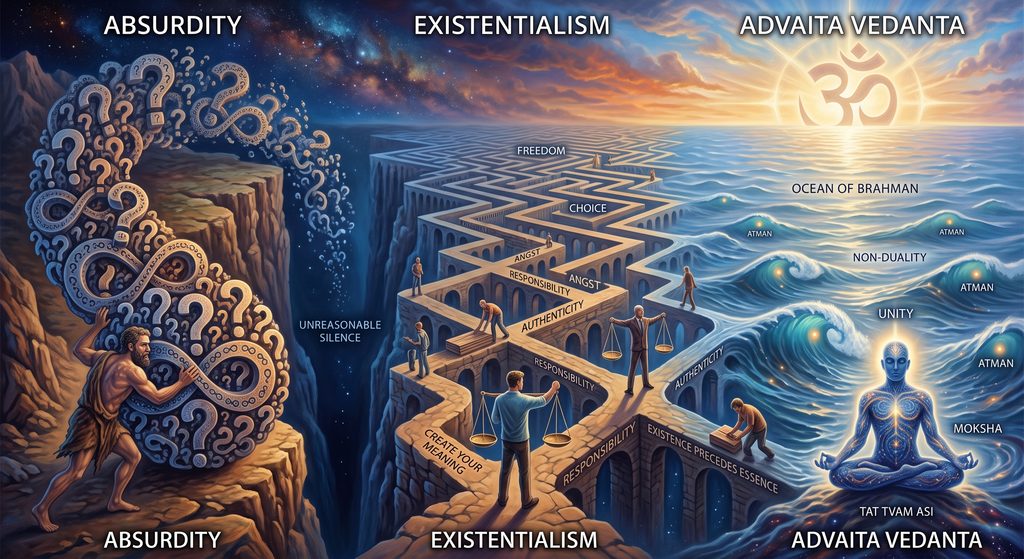
Human suffering and the prevalence of hardships throughout life serve as a testament to an absurd world. What can be the purpose behind numerous disasters that swipe away millions of lives annually without any warning? Petite infants are becoming prey to a system they are not even aware of, let alone the question of their contribution to it.
There are many out there who are so deep in despair that they are expending all their energy just to show up regularly. Life has broken them so bitterly, they have lost all the charm and sight of a normal life. They may not demand luxury, yet they are bereft of the bare minimum. At the same time, affluence and prosperity on an unimaginable scale are flourishing in the same society.
Look at the images and videos coming from the war-torn Middle East or recently inundated and swept-away habitats in Nepal and nearby places in India. These instances are not isolated cases. Human history is full of such destructions and tragedies. Can we look for justice in such cases?
One may talk of the law of karma. They must have done some evil to attract all these punishments. Most of the organised religions have this tenet at the core of their philosophy. This principle is the simple approach of cause-and-effect relationship. However, this argument does not hold water when we fail to find evils done by the infants who have just landed. What harm are they capable of doing?
This does not go well even in cases where we see exploiters and corrupts flourishing and prospering. History shows that Europe colonised most of the world and looted its resources. Then, as per the law of karma, they should pay for the same. But the actuality does not corroborate this view. They are still better off, and most of the exploited are still in jeopardy. Where is the justice then?
The cases discussed above might feel like something of a distant past or uncommon. But what about the day-to-day sufferings! If one observes and analyses closely, one can easily conclude that mere survival is no less than an arduous exercise. There are destitute children, handicapped individuals, tottering families and devastated societies. Their mere existence juice them of all the zeal to search for meaning and praise the existence.
That’s not all. Look at the social structure, machinery, and institutions that have been created to make the world fairer and more just. Police, which exist to protect and safeguard people, are the topmost exploiters and harassers. The public fear more of police than robbers and thieves. If we talk of judiciary, which has been vested with the responsibility to dispense justice and create order in society, it is such a complicated and inaccessible setup for the masses that they never wish to get entangled with.
Educational institutions, which are structures for learning, creativity and innovation, have been found to be the largest crusher of novelty and differences. They try to create a mass that is moulded into a pre-designed framework.
If we analyse all the cases discussed above, we will find nothing but absurdity. Absurdity is the quality or state of being ridiculously unreasonable, illogical, or completely lacking in common sense. It can also refer to a specific foolish action, idea, or situation that is so silly or extreme it seems laughable.
In such a scenario, what are we to do? Where can we discover meaning?
A nihilist will say there is no meaning to life. Accordingly, searching for meaning is a futile exercise. An existentialist will say there is no inherent meaning to life, but we need to make it meaningful by ascribing our own meaning, which is quite subjective. The case of “Myth of Sisyphus” can aptly be discussed here. We all do almost the same thing every day, but we have to start from the beginning the very next day. What are we to do in such a case? We may wonder what we are doing and why we are doing it in the first place.
Life may become more unbearable and perplexing in such a state. Albert Camus says that we should accept it as if there is no escape and start enjoying the process. Rather than struggling to find essence, we should ascribe our meaning and delight in it. Such an approach may give some solace to our scorching soul.
A more reasonable and plausible way can be found in the Advaita Vedanta. It says that whatever is happening is our own deed. We are no different from the one who is both the creator and the creation. So, we can’t hold anyone else responsible for all these. We are illusioned with Maya and feel like we are different from the Creator.
As Sri Ramkrishna Paramhans talks about the conception of Leela. This all is just a play out of the blissfulness of the creator. Though, it still is difficult to accept how a blissful being can play such a cruel game!
The way ahead is not an easy one. What I find tenable is to live while we are alive. Getting lost in facts and analytics may not take us anywhere. But what it is to Live is still a matter of deliberation and further expedition.